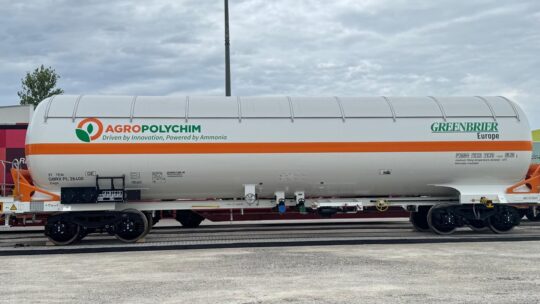
A Fleet of 100 New Ammonia Rail Tank Cars – A Strategic Asset for Agropolychim
Agropolychim is taking a significant step forward in its long-term development by investing in the acquisition of 100 new rail tank cars dedicated to the transportation of ammonia. This strategic decision is driven by the growing need for greater flexibility, predictability, and independence in the logistics of one of our core raw materials – ammonia.
Logistics Independence and Operational Flexibility
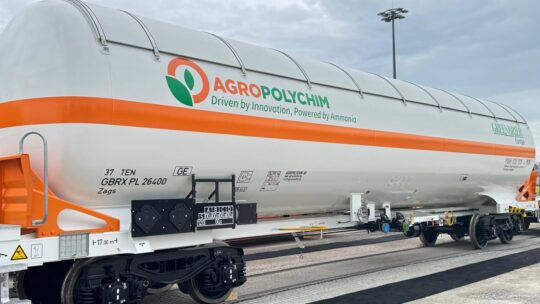
One of the primary motivations behind this investment is to ensure secure and timely deliveries of ammonia, both for internal production requirements and for international trade. Until recently, the company relied on leasing ammonia tank cars, a solution that proved costly and exposed to numerous limitations related to the age and technical condition of the available rolling stock. The newly procured tank cars, manufactured by Greenbrier, are state-of-the-art, fully equipped with modern safety systems, and fully compliant with the latest European regulations, including environmental and noise standards.
Core Objective – Ammonia Delivery
Each tank car offers a net payload capacity of approximately 50 tonnes, enabling Agropolychim not only to secure its own production needs but also to establish itself as a regional logistics hub for ammonia in Southeast Europe. Ammonia remains a critical raw material for numerous industrial plants across the region – including in Serbia, Croatia, Hungary, Romania, and Bulgaria. Reliability and precision in deliveries are essential to avoid production disruptions, which are among the most cost-intensive events in any manufacturing process.
Part of a Broader Strategic Vision
The acquisition of new rolling stock is part of a comprehensive investment program to expand Agropolychim’s production and logistics infrastructure. Over the next four years, the company aims to double the capacity of its nitrogen production line and increase ammonia consumption to 600,000–650,000 tonnes annually. Additionally, it anticipates the delivery of an extra 100,000–250,000 tonnes of ammonia per year to external clients throughout the region.
To support this growth, several parallel infrastructure projects are being implemented alongside the procurement of the first 100 tank cars, including:
- the construction of a third ammonia storage tank;
- the expansion of the company’s dedicated rail terminal;
- securing additional rail time slots on key corridors;
- potential purchase of another 100 tank cars as new markets and client opportunities develop.
International Recognition and Regulatory Compatibility
Agropolychim’s new tank cars will be showcased at Transport Logistic 2025, the leading global trade fair for logistics and transport, taking place in Munich from 2 to 5 June 2025. This prestigious event gathers the entire international logistics industry under one roof. Greenbrier, the manufacturer of our rolling stock, selected Agropolychim’s wagon as a demonstration of its most advanced full-package configuration currently available on the market.
“The fact that our wagons can operate seamlessly across Europe, including in cities with the strictest environmental and noise regulations such as Munich, is a testament to the technological sophistication of the project. For reference – diesel-powered vehicles are no longer permitted in Munich, and the bar for rail freight equipment is even higher, covering safety, noise emissions, and environmental impact.”
— Vladimir Teoharev, Logistics Director
Strategic Advantage Amid Emerging Regulations
Beginning in 2026, the European Union will gradually implement the Carbon Border Adjustment Mechanism (CBAM). This regulatory shift will provide a competitive advantage to companies capable of importing so-called “blue ammonia” – ammonia produced with captured CO₂. Agropolychim is already actively developing the infrastructure necessary to support such deliveries and is positioned to become a reliable regional supplier of low-carbon ammonia – both for its own operations and for industrial clients throughout Southeast Europe.