Ready to be a strategic partner of the state on the road to climate neutrality
Investments in green technologies depend on a simplified regulatory framework and easier access to targeted financing in line with EU strategies
In September, Agropolychim took part in the presentation of the “Roadmap for Decarbonization of Bulgaria’s Energy-Intensive Industry” before relevant ministries and government institutions. The document was developed in coordination with the Bulgarian Federation of Industrial Energy Consumers (BFIEC).
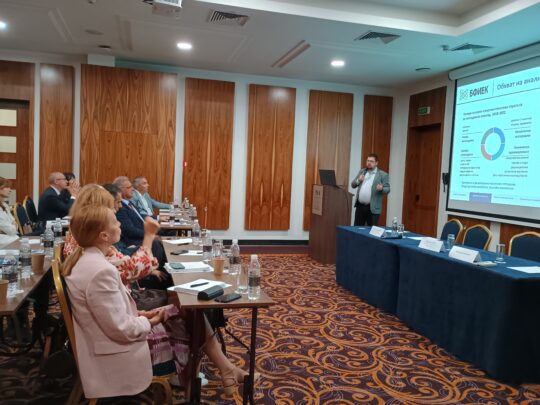 Photo by 3e-news.net
This strategic report, the result of a year-long analysis, outlines the pathway for transforming key sectors such as metallurgy, cement, and chemical industries in order to achieve climate neutrality by 2050 — a goal binding for Bulgaria as an EU Member State and enshrined in the European Climate Law.
The roadmap is based on specific investment intentions of 11 of the most carbon-intensive Bulgarian companies involved in its development, reflecting various levels of project maturity and implementation.
“The document clearly shows that companies have already achieved the maximum possible reductions in their direct greenhouse gas emissions through substantial internal investments. The next steps toward decarbonization require new solutions — related to energy infrastructure for the production, storage, and transport of renewable energy, low-carbon technologies, green hydrogen, and others,” said Maya Stefanova, Director of Ecology and Climate Change at Agropolychim, who participated in the presentation.
“The aim was to highlight the strategic importance of these enterprises for Bulgaria, to demonstrate how much progress has already been made in decarbonizing processes, and to emphasize that further emission reductions — essential for achieving the national EU targets — cannot be accomplished without active institutional support.”
Achieving climate neutrality by 2050 and reducing net greenhouse gas emissions by 90% by 2040 will require significant capital investments. Participants in the presentation concluded that much higher and more costly technologies will be needed — low-carbon and fully green energy, renewable sources, and hydrogen.
“Such projects would be difficult to realize without a simplified regulatory framework and easy access to grant financing, aligned with European strategies, so that these technologies can become feasible in Bulgaria,” added Maya Stefanova.
For Agropolychim, a sustainable transition is possible only through open dialogue and genuine partnership between business and the state.
Longstanding Cooperation with State Institutions
The company has a long-standing tradition of working with the executive authorities and has consistently contributed to the transposition of European environmental legislation into national law.
- 2016–2017: In partnership with the Ministry of Environment and Water (MOEW), Agropolychim contributed to the national regulation transposing the EU Landfill Directive. As the only operator of a phosphogypsum landfill in Bulgaria, the company provided substantiated proposals for specific criteria tailored to its production processes, ensuring a high level of environmental protection.
- 2024: Agropolychim provided expert support to MOEW in implementing the requirements of the Renewable Energy Directive (RED II). Drawing on its extensive experience in using biomass for thermal energy, the company proposed specific legal provisions combining European sustainability criteria with Bulgaria’s land-use specifics.

These examples demonstrate that when decisions are based on real data and industrial experience, regulations become both feasible and effective — serving environmental protection and business competitiveness alike.
Looking Ahead: New Regulatory Challenges
A new wave of EU legislation under the Net-Zero Industry Act will soon need to be transposed into national law. Among the most urgent topics are the Carbon Border Adjustment Mechanism (CBAM) and the third revision of the Renewable Energy Directive, both expected to be implemented in the coming months.
In this process, the role of industry — and particularly of major enterprises such as Agropolychim — is crucial: to provide expert input, anticipate potential challenges, and propose practical solutions.
“Achieving carbon neutrality should not be an end in itself — if companies stop operating, the goal might be met formally, but not in the interest of society and the economy,” noted Maya Stefanova.
Agropolychim reaffirms its readiness to remain a reliable strategic partner to the Bulgarian state, because only through such cooperation can regulations work effectively — both for the environment and for the economy.