Agropolychim: Europe’s Food Security Begins with Preserving Its Own Production
“We cannot protect what we do not produce.” With this message, Agropolychim highlights one of the most pressing issues facing the future of European agriculture: how Europe can ensure its food security without sacrificing its own production capacity and competitiveness.
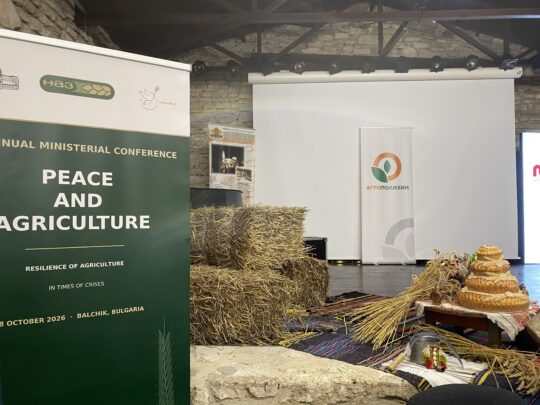
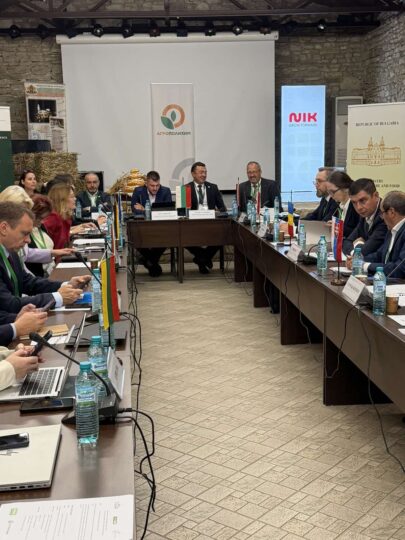
The company supported the 12th International Ministerial Conference “Bread of Peace”, held from 6 to 9 October in Balchik, Bulgaria. Organised by the National Grain Producers Association (NGPA) and the Bulgarian Ministry of Agriculture, the event brought together young farmers, representatives of European institutions, agricultural organisations and partners from various countries to discuss the resilience of agriculture in times of crisis.
Agropolychim was represented by Maya Stefanova, Director of Environment and Climate Change, whose participation reflected the company’s long-standing commitment to the development of a strong and competitive European agricultural sector.
Against a backdrop of geopolitical uncertainty, high energy prices and rising production costs, the issue of food security is becoming increasingly important. For Agropolychim, food security means much more than ensuring that sufficient food is available on the market. It means preserving Europe’s capacity for domestic agricultural production and safeguarding the strategic industries on which it depends.
Sustainable agriculture is impossible without secure access to the essential resources needed for food production. Mineral fertilisers play a particularly important role in this regard. According to Maya Stefanova, dependence on imported fertilisers may appear economically advantageous in stable times, but during crises, supply chain disruptions and periods of international market volatility, it becomes a significant risk.
At the same time, European fertiliser producers face a dual challenge: reducing their carbon emissions and environmental impact while maintaining their competitiveness in global markets.
For Agropolychim, this transition is not merely an ambition but an ongoing process supported by substantial investment. Over the years, the company has invested hundreds of millions of euros of its own funds in modernising its production facilities, improving energy efficiency and reducing its environmental and carbon footprint.
However, these efforts come at a cost, which is also reflected in the expenses borne by farmers. European farmers operate under some of the world’s strictest environmental standards, while competing with imported agricultural products produced under different conditions and often at lower costs.
An additional challenge arises from the Carbon Border Adjustment Mechanism (CBAM), whose primary objective is to prevent carbon leakage by imposing a carbon-related charge on emissions embedded in goods imported into the EU. However, due to significant systemic and functional shortcomings, the mechanism fails to achieve this objective effectively, while further exacerbating inequalities across the food production value chain.
European farmers bear the increasing costs of the climate transition, including through fertiliser prices, while imported agricultural products are not subject to an equivalent carbon adjustment. As a result, rather than protecting European production against carbon leakage, the current regulatory approach creates conditions that could drive industrial and agricultural production outside the EU, increase dependence on imports and weaken European food security.
According to Agropolychim, this is a contradiction that Europe must address if it is to preserve both its agricultural sector and the strategic industries that support it. Otherwise, there is a risk that an increasing share of production, investment and jobs will move outside the EU.
For this reason, Agropolychim, together with its partners from the National Grain Producers Association, has repeatedly and publicly advocated for policies that not only set ambitious climate targets but also create the practical conditions necessary to achieve them by ensuring fair and equitable competitive conditions for European producers.
Agropolychim’s participation in and support for the “Bread of Peace” initiative are a natural continuation of this commitment. The forum brings to the forefront issues that affect not only farmers but the entire food production value chain across Europe.