CBAM – a bridge to sustainability or a barrier for Еuropean agriculture in a global context?
The mechanism may reduce the profitability of Bulgarian farmers depending on crop type and market exposure
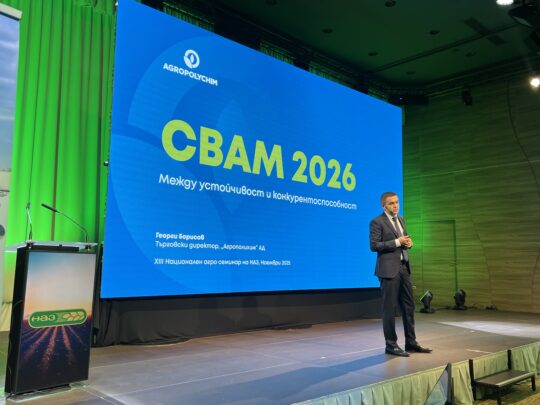
European agriculture is facing a new challenge with the introduction of the Carbon Border Adjustment Mechanism (CBAM). This regulation, which becomes effective on 1 January 2026, is part of the European Commission’s policy to achieve climate neutrality and introduces a levy on the import of carbon-intensive goods. Its objective is to level the playing field between EU producers, who pay for their carbon emissions, and producers from countries where such carbon costs do not exist.
As highlighted by Georgi Borisov, Commercial Director of Agropolychim, during his presentation at the XIII National Agro Seminar 2025 “Agriculture in Restart”, “CBAM requires a coordinated approach and constructive engagement between industry, farmers and institutions.” He stressed that sustainability and competitiveness must be viewed jointly: “Sustainability is inconceivable without preserving the sector’s competitiveness — the two must be treated as interconnected elements.”
In theory, CBAM is designed to protect European producers from imports originating in countries with less stringent climate standards. Behind the principle, however, lies an economic reality that will place considerable pressure on both industry and farmers, who ultimately bear the cost of the transition.
From the perspective of fertilizer production, CBAM is intended to encourage cleaner technologies, with ammonia being the most affected input — a key raw material for nitrogen, NP and NPK fertilizers. Between 2026 and 2034, the gradual removal of free emission allowances under the ETS, combined with carbon costs applied to imported fertilizers, will significantly increase the price of key products such as ammonium nitrate, urea, NP and NPK formulations. In practice, every tonne of fertilizer produced or imported into the EU will carry an additional cost corresponding to its carbon footprint. By 2034, free quotas will be completely phased out, and carbon costs will be fully reflected in product pricing and ultimately in farmers’ production expenses.
Borisov emphasized that these developments are not hypothetical but represent a clearly defined regulatory trajectory. As early as the beginning of the next decade, the production of one tonne of ammonium nitrate could incur an additional carbon cost of around €150 per tonne, assuming carbon allowance prices range between €120 and €200.
Over the coming years, Europe is expected to become the market with the highest fertilizer prices globally. This will directly affect agricultural production costs, reducing farmers’ competitiveness and shrinking margins by an estimated 25–50%, depending on crop and market. For export-oriented countries such as Bulgaria and Romania — where a significant share of grain is destined for third-country markets, particularly in North Africa and the Middle East — the implications may be substantial. Buyers in these regions are unlikely to absorb the higher cost of “greener” European products, leaving farmers unable to offset rising fertilizer expenses.
Borisov noted that “European producers will operate in a market environment in which their competitors outside the EU do not face comparable carbon-related costs. This leads to a significant imbalance in competitive conditions.” Farmers within the EU pay a carbon-driven component embedded in the cost of fertilizers, while producers from Ukraine, Russia and other third countries do not incur such costs, neither in production nor upon entry into the EU market.
In its current design, CBAM does not provide sufficient economic incentives for investments in low-carbon technologies — investments that are essential for accelerating the sustainability transition. Without support measures and an open dialogue with policymakers, there is a risk that the mechanism may produce the opposite effect of its intended purpose: encouraging imports over local production and promoting “grey” products whose carbon levy is simply paid, rather than “blue” (low-carbon) products whose higher cost reflects real technological investment and limited market availability.
Borisov posed a central question: “On which global playing field can we meet other competitors and still have a realistic chance of success?” When only European producers bear the full carbon cost burden, while their international competitors do not, the competitiveness of the entire sector is fundamentally challenged.
An additional concern is the lack of clarity regarding how revenues from CBAM will be allocated. If these funds are not channelled back into supporting farmers and sustainable manufacturing, the effect may be counterproductive — increasing financial pressure on agricultural producers. Borisov reiterated this point: “We understand the penalties, but where are the incentives to maintain competitiveness? There is a clear need for mechanisms that encourage investment in low-carbon technologies and support businesses that have already taken steps in this direction.”
As a leading fertilizer producer in Southeastern Europe, Agropolychim supports the goals of the green transition and is actively investing in technologies that reduce its carbon footprint. The company is among the early adopters in the European Union integrating low-carbon blue ammonia into fertilizer production, using imported blue ammonia as a feedstock for blue ammonium nitrate. As Borisov noted, farmers “have not yet felt the premium the company pays for this resource,” but “from 2026 onward, the effect will become unavoidable” due to the evolving regulatory environment.
We firmly believe that the future of the industry lies in sustainable production. However, this transition cannot be achieved if the financial burden is placed solely on manufacturers and farmers, without an open and constructive dialogue with institutions.
The green transition is a shared responsibility — across industry, policymakers and the agricultural community. Only by working together can we ensure meaningful and sustainable progress that does not compromise the sector’s long-term viability. As Borisov concluded: “Only through open and consistent dialogue among all stakeholders can we identify a balanced approach that aligns climate objectives with the preservation of competitiveness.”