“Everyone is equal, but some are more equal”: how CBAM distorts the fertiliser market
CBAM creates uncertainty in the fertiliser market and puts pressure on European agriculture
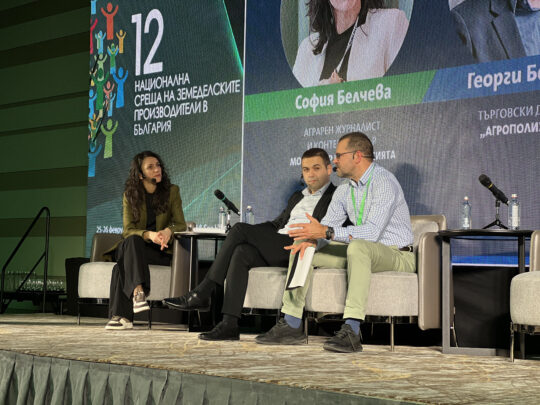
The introduction of the Carbon Border Adjustment Mechanism (CBAM) is already having a tangible impact on the fertiliser market and on the competitiveness of European agriculture. This became clear during the 12th National Meeting of Agricultural Producers, held at the end of February in Kazanlak.
The discussion featured Georgi Borisov, Commercial Director of Agropolychim AD, and Boyan Rashev, expert in environmental and resource management. The conversation outlined the first effects of the new regulation and the long-term risks for the industry and the agricultural sector.

Uncertainty in the fertiliser market after the launch of CBAM
“If we had to describe the fertiliser market since the beginning of 2026 in one word, that word would be ‘uncertainty’,” said Georgi Borisov.
The data confirms this. In January 2026 – the first month after CBAM entered into force – imports of nitrogen fertilisers into the EU fell by more than 80% compared to the same month a year earlier.
“To some extent, these high percentages are driven by the significant imports in December 2025, carried out preventively by companies before the mechanism entered into force, but they are also influenced by other factors,” Borisov explained.
Over the past three years, Agropolychim has been among the most active companies in Europe on the topic of CBAM. According to Borisov, only after the mechanism was actually introduced did the European Commission begin to realise what the consequences for industry and the agricultural sector could be.
On 7 January, following strong pressure from countries such as France and Italy and in response to the emerging risks, the European Commission introduced the so-called Article 27a, which allows the temporary suspension of CBAM obligations “for certain goods in the event of unforeseen circumstances”. Bulgaria also issued an official position.
“The situation at the beginning of the year shocked both fertiliser producers and users. New volumes began to be imported much more cautiously, while uncertainty around pricing increased,” Borisov added.
Administrative chaos and loopholes in the mechanism
According to Boyan Rashev, CBAM is only a symptom of a deeper problem.
“CBAM is trying to patch something much bigger – the Emissions Trading Scheme (ETS). Over-regulation in Europe leads to industries moving outside the EU, and this ‘patch’ creates even more problems,” he believes.
A second phase of the ETS is also forthcoming, which will affect the economy even further. From 2028, carbon emissions will also be charged for the fuels used in transport, agricultural machinery and heating.
“This means that not only industry but each of us will pay directly for carbon emissions,” Rashev warned.
The expert is convinced that the introduction of CBAM is accompanied by serious practical challenges. The mechanism covers a number of heavy industries – fertilisers, metals, energy and the chemical industry – but in reality its application is proving extremely complex.
“CBAM came with an enormous administrative burden and directly interfered with trade. EU bureaucrats assume that since Europe has had an Emissions Trading Scheme since 2005, the rest of the world can easily calculate its carbon emissions. But that is not the reality,” Rashev commented.
An additional problem is the inconsistent application of the regulation. For example, steel is subject to CBAM and steel pipes are also covered, but pipes with a certain degree of processing may already fall outside the mechanism.
“This creates huge confusion and constant disputes over whether a given product falls under CBAM or not. Naturally, everyone is looking for ways to avoid paying the levy,” the expert explained.
Agriculture – the sector without protection
For farmers, the situation is even more unfavourable. According to Georgi Borisov, in this sector there are neither winners nor losers – only losers.
The reason is simple: agricultural products are not protected by CBAM, unlike the example of steel pipes. Neither wheat nor corn are subject to CBAM.
While European farmers pay the carbon price indirectly through fertilisers and production, imports of grain and other agricultural products into the EU are not subject to such a levy. This creates serious market distortions, especially for countries such as Bulgaria, whose agriculture is strongly export-oriented.
“We compete in the most competitive market – the Black Sea region – with countries that do not charge any carbon tax. At the same time, we sell to markets such as Egypt or Saudi Arabia, where nobody is interested in whether the production has paid for carbon emissions,” Borisov added.
Following the launch of CBAM, worrying market trends are also emerging. So-called “phantom companies” have begun to appear on the market – companies trading fertilisers but planning to cease operations before the actual payment of the carbon levy becomes due.
This creates a dangerous precedent and further undermines market stability. Ultimately, the cost of this chaos is borne both by farmers and by end consumers.
What CBAM will mean in the future
The mechanism will expand gradually. In 2026 the effect of CBAM is around 2.5%, but by 2034 it will reach 100%.
“If today we are talking about an effect of between €40 and €100 per tonne of fertiliser, by 2034 the amount could exceed €200,” the Commercial Director of Agropolychim predicted.
This means price increases of around 20% already today, and potentially 50% or more in the future, depending on the price of carbon emissions.
CBAM and Agropolychim’s operations
Ammonia falls directly within the scope of CBAM. In this sense, the mechanism affects Agropolychim’s activities in several directions.
The company is an importer of ammonia, a key raw material for the production of nitrogen and compound fertilisers; an importer of finished fertilisers; and an active trader on the fertiliser market.
Although CBAM obligations for imports carried out in 2026 will be settled in 2027, the expected cost is already being reflected in prices.
“It is impossible not to include CBAM in the price – regardless of whether we are talking about a raw material or a finished product,” Borisov explained.
Despite regulatory uncertainty, Agropolychim is actively working to reduce the carbon footprint of its production.
“The company is almost carbon-neutral – we do not use natural gas either for ammonia production or for steam generation,” Borisov explained.
Back in 2023, Agropolychim became the first company in Europe to import blue ammonia – ammonia with partially captured carbon emissions. Combined with the use of biomass for steam production, the company succeeded in producing and placing on the market the first batch of blue ammonium nitrate in Europe, a product with a significantly lower carbon footprint.
Production has continued in the following years, with new quantities of blue ammonium nitrate appearing on the market again in 2026.
“Our goal is gradually to introduce products with a lower carbon footprint and in this way limit the effect of CBAM. But it cannot disappear entirely,” Borisov emphasised.
A common position for suspending and rethinking CBAM
According to the participants in the discussion, the key to solving the problem lies in closer cooperation between farmers and their organisations, industry and national governments.
“The EU is not the USSR – not everything produced here is sold on the internal market,” Georgi Borisov commented.
For example, Agropolychim exports around 50% of its production, which places the company – as well as European farmers – at a disadvantage on international markets where competitors do not pay a carbon levy.
This is why a clear and unified position from the entire sector is needed. The more EU countries express a common stance – similar to the initiatives of France and Italy earlier this year – the stronger the pressure on the European Commission will be.
The aim of this common position should be the suspension and comprehensive reconsideration of the mechanism, as in its current form CBAM does not function effectively and creates serious market distortions. Only through such an approach can the competitiveness of the European agricultural sector be preserved.
“The key word is competitiveness and whether regulations such as ETS and CBAM protect it or undermine it,” Georgi Borisov concluded.