Agropolychim invests in sustainable production with a new shipment of low-carbon “blue” Ammonia
The company calls for an open dialogue on the EU’s Carbon Border Adjustment Mechanism (CBAM), which could pose significant challenges for Bulgarian farmers.
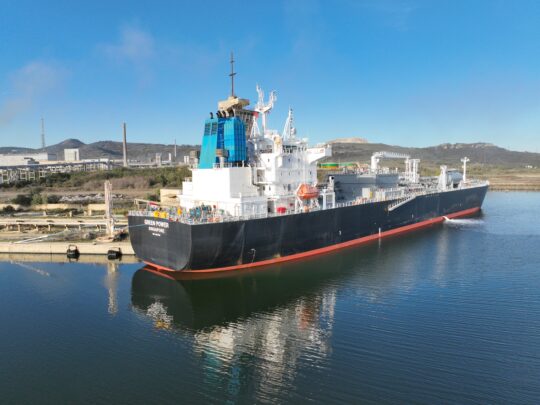
The vessel LPG/C Green Power v.2 delivered 5,000 metric tons of “blue” ammonia from the United States to Varna West Port. The quantity will be used for the production of fertilizers with a lower carbon footprint. These decarbonized fertilizer products will be distributed with priority to farmers practicing regenerative agriculture, as well as to those supplying sustainably sourced biomass used for Agropolychim’s steam generation needs — a process that enables the company to maintain near full energy independence from natural gas.
Agropolychim believes that sustainable development is a shared responsibility and that it is essential to support the stakeholders across the value chain who are already investing in change.
With this new shipment of “blue” ammonia, Agropolychim AD will reduce its carbon footprint by approximately 5,450 tons of CO₂ emissions — an amount that nature would offset only over several decades. According to the company’s experts, this reduction is equivalent to the carbon absorption capacity of around 5,000 century-old broadleaf trees spread across 80 hectares of forest land.
The project aligns with Agropolychim’s long-term strategy to reduce its carbon footprint and increase resource efficiency in production.
Despite these positive steps toward decarbonization, the sector faces a major challenge — the upcoming implementation of the EU’s Carbon Border Adjustment Mechanism (CBAM), effective January 1, 2026.
While the mechanism aims to create a level playing field between EU producers and importers from countries without carbon pricing, its practical application raises serious questions and concerns.
There are growing fears that Europe will face increasingly higher costs for both carbon allowances and carbon-related import taxes, making European fertilizers among the most expensive in the world.
For export-oriented agricultural economies such as Bulgaria, this could lead to higher production costs, rising prices along the value chain, and reduced competitiveness on the global grain market.
Farmers will pay more for the same raw materials while competing internationally with producers not subject to comparable carbon charges.
Without a clear plan to support industry and agriculture during the transition to low-carbon production, the sustainability of European exports could come under significant pressure.
Commenting on the upcoming implementation of CBAM, Philippe Rombaut, Chairman of the Board of Directors of Agropolychim AD, outlined the main challenges facing farmers and the need for adequate support:
“By 2035, the cessation of free CO₂ quotas and the full implementation of CBAM could cost European farmers a guestimate of EUR 3 billion more for fertilizers alone,” Rombaut noted.
“Nothing has been foreseen to compensate farmers whose theoretical margins will be reduced by approximately 40%. Proper financial incentives must be provided to enable farmers to take the necessary steps to reduce on-farm emissions and to absorb the extra cost of purchasing “blue” fertilizers and adopting regenerative agricultural practices,” he added.
“To claim that the end consumer will bear the cost sounds appealing, but it is ‘intellectually incorrect’ — especially when it comes to the large volumes of grain that Europe exports outside the EU,” Rombaut emphasized.
In an interview with S&P Global Commodity Insights, focused on the challenges facing Europe’s fertilizer industry under CBAM, Rombaut reiterated that a sustainable transition requires open dialogue and consistent support for both industry and farmers to ensure that the green transition remains economically viable and realistic.
With its latest deliveries and ongoing investments, Agropolychim reaffirms its role as an active participant in the sustainable transition, demonstrating that technological progress and economic logic can advance together.
The company continues to implement low-carbon technologies and circular production models, focusing on partnerships with farmers applying regenerative practices and producers committed to sustainable resource management.
To fully realize this potential, the green transition must be supported by consistent policies and open collaboration between industry, institutions, and agriculture.
Only through such shared commitment can the transition be realistic, effective, and sustainable in the long term
Related articles: